
Reserve Bank Governor Sanjay Malhotra on Friday said the key policy rates will remain at low levels for a long period and may go down even further.

Fitch Ratings on Friday said persistently higher oil prices could cause India's retail inflation to rise faster than the expected gradual pace, and lead to a slowdown in economic growth in the first half of financial year 2026-27 (FY27).

RBI Governor flayed easy monetary policy of central banks in advanced economies saying it is "more cause than medicine".

With inflation turning negative, industry has been demanding interest rate cuts to propel demand. However, RBI Governor D Subbarao had said there is no threat of deflation as food and crude oil prices are still firm.

The Reserve Bank of India (RBI) and the central government have introduced a package of measures, including tax exemptions for FPIs on government securities and a concessional foreign-exchange swap facility, aiming to attract up to $50 billion in foreign capital. This initiative is designed to strengthen India's balance of payments and potentially cover the projected BoP gap for FY27.

Raghuram Rajan, who was Chief Economic Advisor in the Finance Ministry before taking over as RBI Governor on September 4, is scheduled to announce the next mid-quarter policy review on December 18.

The Delhi government's Health Department has received an audit report highlighting alleged financial and administrative irregularities within the Delhi Medical Council (DMC) between 2019 and 2025.
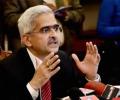
Following are the highlights of the RBI's first monetary policy statement of 2022-23 unveiled by Governor Shaktikanta Das: Policy repo rate unchanged at 4%; marginal standing facility rate & bank rate too remain unchanged at 4.25%. Monetary stance to be accommodative with focus on withdrawal of accommodation to keep inflation within target. GDP growth projection for FY'23 slashed to 7.2% from 7.8%; growth projections based on assumption of crude oil (Indian basket) price at $100 a barrel during FY'23. Inflation forecast hiked to 5.7% for FY'23 from 4.5%.

The RBI has hiked repo or short-term lending rate up by 0.25 pc to 7.75 pc.

The Reserve Bank of India (RBI) has proposed new measures to combat financial fraud in digital payments, including lagged credit for authorised push payments and a 'kill switch' for users to disable all digital transactions.

The Sri Lankan government attributes the sharp depreciation of the rupee against the US dollar to the ongoing conflict in West Asia, citing increased costs for essential imports like gas, fertiliser, and oil.
Highlights of the third quarter review of the monetary

The year 2022 saw the Reserve Bank of India (RBI) start acting on the policy repo rate after a gap of two years. The six-member monetary policy committee of the RBI reduced interest rate sharply - by 115 bps - when Covid-19 struck in 2020. In March 2020, days after the nationwide lockdown was announced, MPC in an unscheduled meeting reduced the repo rate by 75 bps, followed by another 40 bps in May. Status quo was maintained for the next two years since the May repo rate hike.
There is no shortage of liquidity, so interest rates in the overnight call money market continue to stay below 1 per cent.
The central bank is yet to consider actions such as a rate hike or mobilising dollar inflows from non-resident Indians to boost forex reserves as it cannot afford to continue with them for long when the rupee's internationalisation tops its agenda, explains Tamal Bandyopadhyay.

S Mahendra Dev, chairman of the Economic Advisory Council to the Prime Minister, expressed confidence that the rupee would stabilise around the 92-93 level against the US dollar, despite geopolitical tensions, and that foreign investment flows would return.

Former Reserve Bank Governors do not seen any harm in central bank consulting the government before firming up monetary policy initiatives saying such an step would not amount to infringement on its independence.

The Reserve Bank of India (RBI) has projected a 6.9 per cent GDP growth for the current financial year, citing concerns over commodity prices and supply chain disruptions stemming from the West Asia crisis.

The bull-market in gold is not yet over and prices can rise to $6,200 an ounce (oz) by mid-2026, up nearly 25 per cent from current levels, according to UBS.

Indian stock markets experienced a significant rally following the announcement of a US-Iran ceasefire, coupled with a drop in crude oil prices. The Sensex and Nifty both closed nearly 4 per cent higher, mirroring gains in global markets.

The University of Chicago has conferred its Alumni Award for Professional Achievement to India's former chief economic adviser Krishnamurthy V Subramanian, the first Indian economist to receive the honour since 1941.
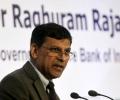
We may now be experiencing the darker side of the massive monetary stimulus of past years, said Rajan.

India's wholesale price inflation surged to 3.88 per cent in March, marking the fifth consecutive monthly increase, primarily driven by a sharp rise in crude petroleum, natural gas, and manufactured items amidst the West Asia crisis.

India's wholesale price inflation (WPI) increased for the fourth consecutive month in February, reaching 2.13 per cent, primarily due to rising prices of food and manufactured goods, according to government data.

Stock markets closed higher on Friday after the Reserve Bank of India kept its benchmark interest rate unchanged as expected and proposed allowing banks to lend to Real Estate Investment Trusts (REITs) with certain prudential safeguards to deepen the financing pool for the real estate sector.
.jpg)
The truth is the government and the Reserve Bank enjoy a free, frank and cordial relationship.

Shrugging off concerns over the depreciation of rupee, the RBI has cut interest rate by 25 basis points to 5.25 per cent in a bid to further bolster economic growth, which rose to a six-quarter high of 8.2 per cent in the second quarter of the current financial year.

Ashok Lahiri, a distinguished economist with experience in government, the private sector, and electoral politics, has been appointed as the new Vice-Chairman of NITI Aayog, tasked with strengthening India's reform trajectory and policy-making.

Indian stock market benchmark indices Sensex and Nifty experienced a significant decline, driven by escalating tensions in the Middle East and rising crude oil prices.
The Reserve Bank of India hiked key interest rates by 0.25 per cent each in the last two reviews to tame inflation.
The rupee appreciated 13 paise to close at 90.34 against the US dollar on Thursday, on trade deal optimism and overnight decline in commodity prices, even as the upside remained capped as investors look for more clarity on the India-US trade deal.

Maharashtra's Governor and Chief Minister, along with other state leaders, paid tribute to Dr. B.R. Ambedkar on his 135th birth anniversary, recognising his profound impact on social justice, equality, and the Indian Constitution.

India emerged reasonably well from 2025. But now, the oil shock and war-related supply disruptions have again driven funds out of India and significantly weakened the rupee, points out Ajay Chhibber.
Brent crude prices surged sharply on Monday, rising by more than 25 per cent to $116.5 per barrel, amid the ongoing conflict in West Asia, which has made crude prices bullish.

'Economic activity appears to have peaked in the second quarter of FY26, with industrial output, exports, and business confidence all softening from October 2025.'

'Rate cut looks unlikely and there is reason to believe that the cycle is over.'

Silver and gold prices declined sharply in the futures trade on Friday as traders booked profits at elevated levels after a record-breaking rally, tracking a bearish sentiment in global markets and a rebound in the US dollar.

Lenders are actively monitoring gold price volatility, prompting them to ask borrowers for additional gold collateral or partial principal repayment when loan-to-value (LTV) thresholds are breached, particularly for loans disbursed in February.

Overall economic activity continued to hold up in November with demand conditions remaining robust, thanks to strengthening urban demand, but manufacturing and rural demand showed some signs of deceleration even as services remained strong, according to an article on the State of the Economy written by Reserve Bank of India (RBI) officials in the central bank's December bulletin.

Experts said a future rate cut would depend on the inflation.
